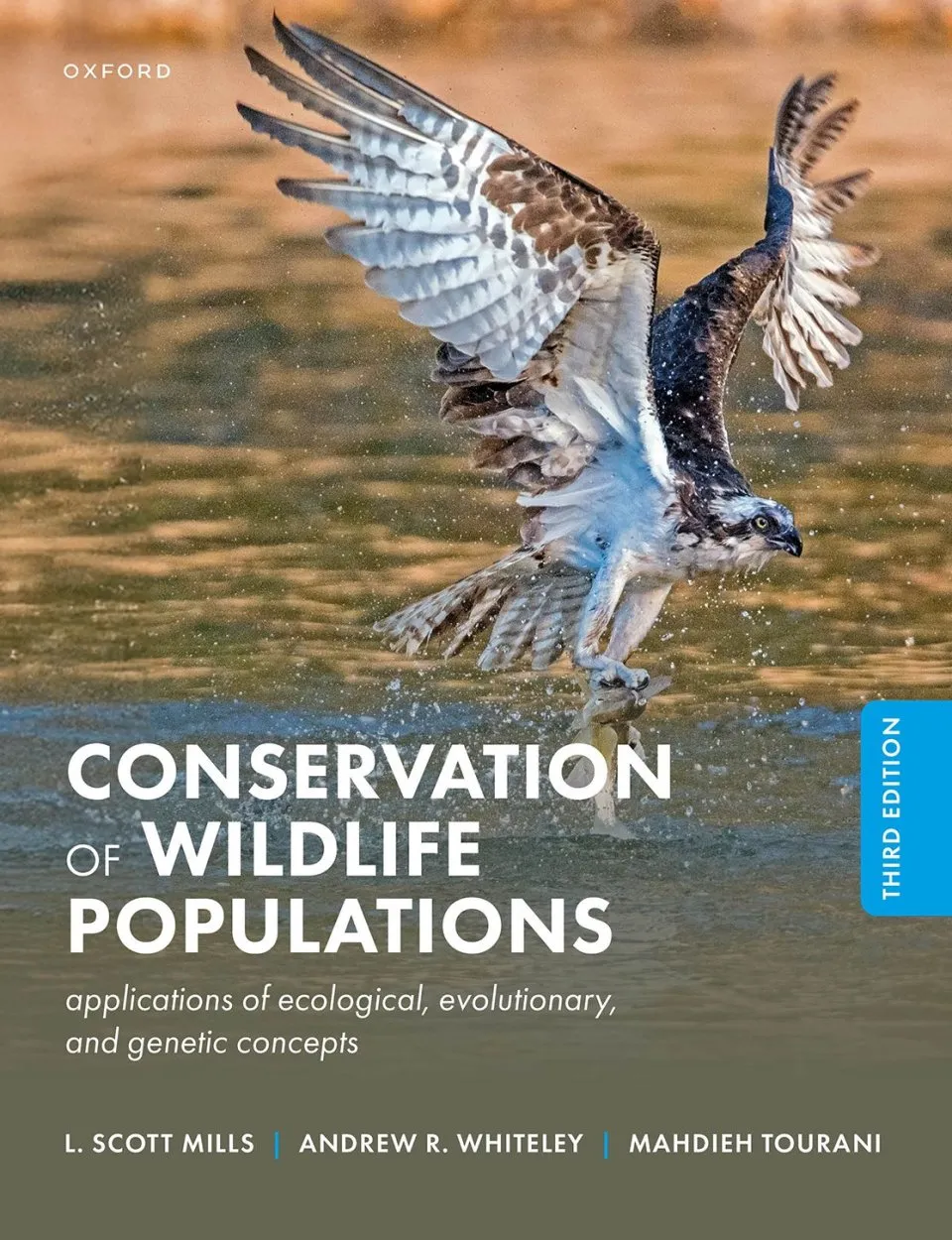
| Auteurs | L Scott Mills, Andrew R Whiteley, Mahdieh Tourani |
| Taal | Engels |
| ISBN | 9780192898173 |
| Uitgever | Oxford University Press |
| Pagina's | 384 |
Afmetingen | 246 x 190 mm |
| Bindwijze | Paperback |
| Afbeeldingen | 87 figuren |
| Jaar van uitgave | 2025 (3e editie) |
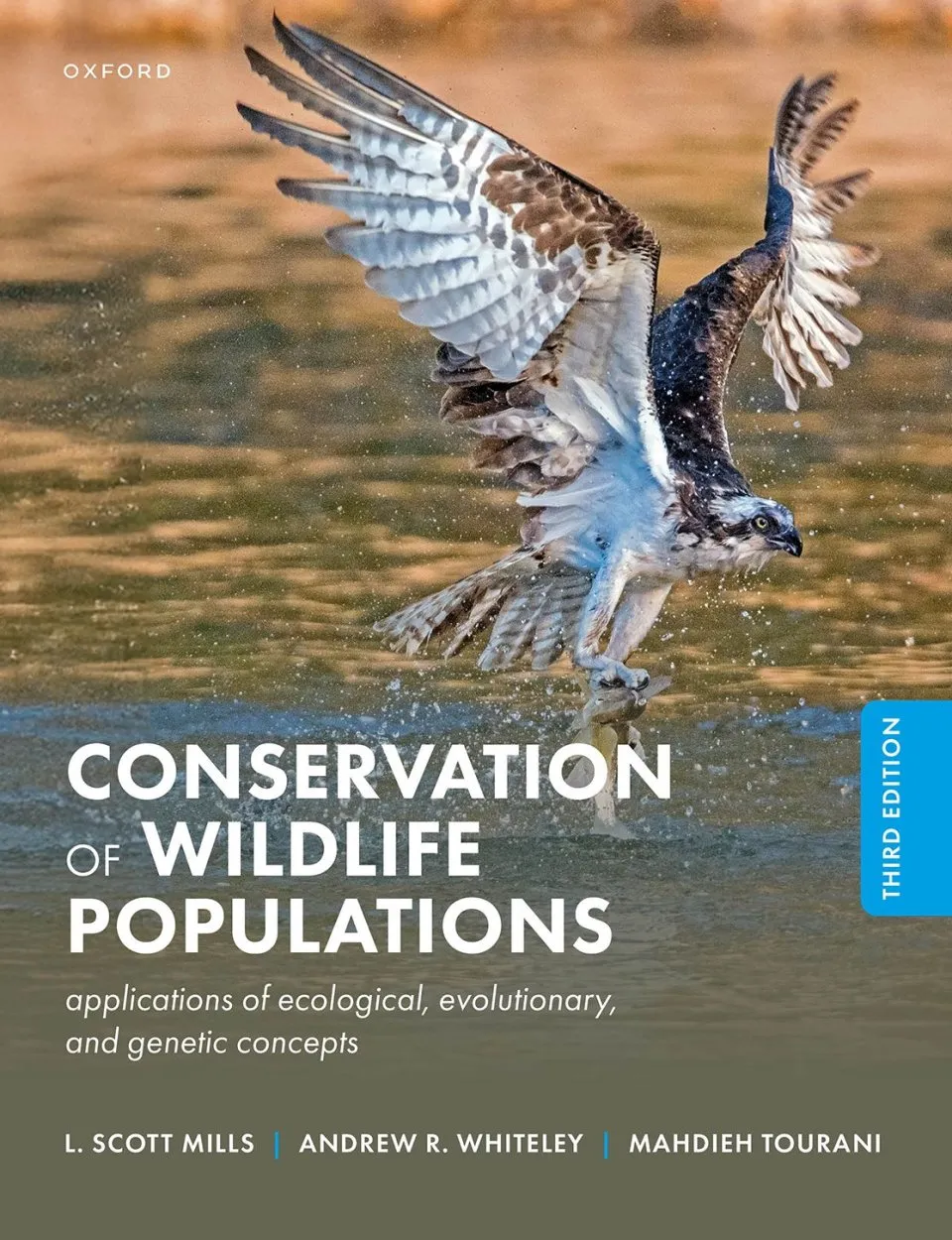
In a world where threats of cataclysmic extinction loom and sustainable harvest approaches are essential, applied population ecology has never been more crucial. Conservation of Wildlife Populations, third edition, provides evidence-based insight into how extinctions and human-wildlife conflicts can be minimised. L. Scott Mills, Andrew Whiteley, and Mahdieh Tourani blend rigorous science with practical solutions to illuminate paths where science and action can bring hope.
Thoroughly updated since the second edition, Conservation of Wildlife Populations bridges the full scope of applied wildlife population ecology, spanning conservation and wildlife biology, ecology, conservation genetics, evolutionary biology, and environmental studies. This new edition includes updated references and expanded global case studies based on both terrestrial and aquatic wildlife species. With an engaging writing style and real-world examples, this third edition shows how a broad range of practical ecological and evolutionary principles can lead to efficient and sometimes non-intuitive conservation management in a rapidly changing world.
Engaging and approachable, yet thorough and solutions-oriented, this is a must-read book for students and practitioners in ecology, wildlife biology, and conservation genetics. Undergraduate and postgraduate students will be equipped to advance conservation management and research, while field practitioners will find the scientific basis for making efficient and effective conservation decisions.
Contents
Part I: Background to Applied Population Ecology
1. The Big Picture: Wildlife population ecology at the interface of humans and biodiversity
2. Gaining Reliable Knowledge: How do we know what we know?
3. Genetic Concepts and Tools to Support Wildlife Population Ecology
4. Estimating Population Size and Vital Rates
Part II: Population Processes: The Basis for Conservation Management
5. Exponential (or Geometric) Change: The simplest way to describe and project population dynamics
6. All Stage Classes are not Equal in their Effects on Population Growth: Structured population projection models
7. Density-Dependent Population Change
8, Predation and Wildlife Populations
9. Genetic Variation and Fitness of Wildlife Populations
10. Dynamics of Multiple Populations
Part III: Applying Knowledge of Population Processes to Problems of Declining, Small, and Harvestable Populations
11. Population Responses to Human-Caused Stressors: Move, adjust, or die
12. Dynamics of Small and Declining Populations: Viability and extinction
13. Sustainable Harvest Principles, Models, and Best Practices
About the authors
Dr L. Scott Mills has recently retired as Associate Vice President of Research for Global Change and Sustainability, and a Wildlife Biology Professor at the University of Montana. He also holds a Research Professor appointment at Inland Norway University of Applied Sciences. From 2013 to 2016 he was a Chancellor's Faculty Excellence Fellow in Global Environmental Change and Human Well-Being at North Carolina State University. His honors include an NSF Early Career Award, John Simon Guggenheim Fellowship, and Fulbright Specialist Award. He has testified before the US Congress on endangered species science and has contributed to Intergovernmental Panel on Climate Change (IPCC) reports.
Dr Andrew R. Whiteley is an Associate Professor of Fisheries and Conservation Genomics at the University of Montana. His position is in the Wildlife Biology Program and Department of Ecosystem and Conservation Sciences within the Franke College of Forestry and Conservation. His research broadly involves understanding population viability of fish populations, along with various other organisms. He earned a US National Science Foundation Early Career Award and has published more than 80 research papers in his field.
Dr Mahdieh Tourani is an Assistant Professor of Quantitative Ecology at the University of Montana. She teaches quantitative courses to graduate and undergraduate students in the Wildlife Biology Program and Department of Ecosystem and Conservation Sciences within the Franke College of Forestry and Conservation. Her research broadly involves developing and applying analytical models to wildlife monitoring data at local to global scales. She develops decision support tools to facilitate the use of statistical models in wildlife management and inform conservation of wildlife populations across the globe.