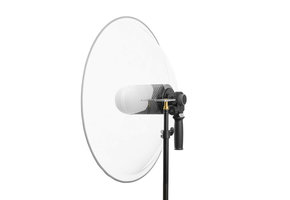
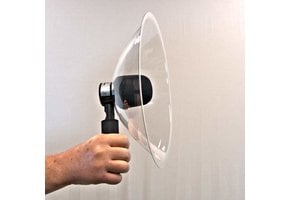
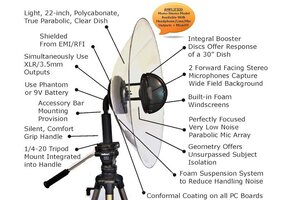
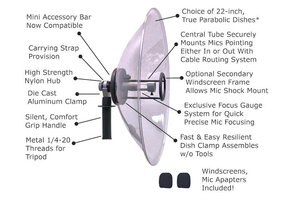
When choosing a parabolic microphone, several characteristics are important:
Mono or stereo: Mono is primarily suitable for recording a single sound source as directly as possible. Stereo, on the other hand, offers more spatial information. As mentioned in a previous question, mono is useful for research setups. This is, for example, for recording migratory birds at night (Nocturnal Migration, NOCMIG). There is no redundant data in this case. Our most sensitive parabolic microphone for this purpose is the
Hi-Sound Mono Evo from Dodotronic. This parabolic microphone is compatible with the
Tascam DR-05XP (3.5mm PIP connector) or the
Tascam DR-40XP (XLR connector). This microphone is so sensitive that no additional pre-amplification is required.
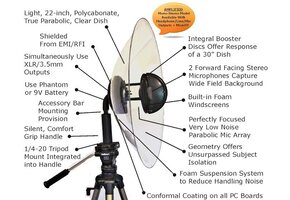
Disc size: A larger dish can offer greater directivity, while a compact dish is easier to carry around. The size of the dish also largely determines which frequencies are focused. The larger the dish, the more lower frequencies are amplified by the dish. In the case of bird sounds, a smaller dish is often sufficient.
Connection: check if the microphone connects to the recorder, camera, or smartphone being used. Common connections are 3.5mm and XLR.
Self-noise: for soft nature sounds, low self-noise is important to properly record subtle sounds. All built-in microphones have a signal-to-noise ratio greater than 80dB, which is very good.
Wind protection: for field recordings, good wind protection is essential to limit wind noise.
Weight and transport: a lightweight or foldable parabolic microphone can be practical when working in the field for extended periods.
Compatibility: some systems are complete, while others are intended to be combined with a separate microphone or recorder.
At Veldshop, parabolic microphones are available in various designs and price ranges.
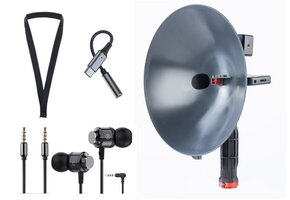
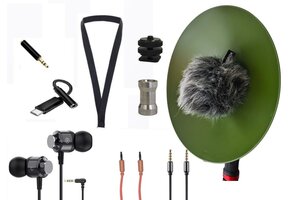
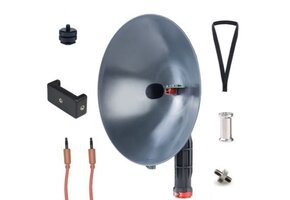
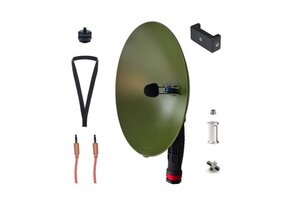
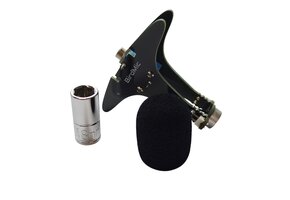
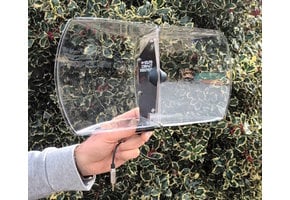
BirdFox offers compact models specifically aimed at observing and recording birds. Due to their practical size, these systems are suitable for birdwatchers and for fieldwork where portability is important.
In the higher segment are, among others, the professional parabolic microphones from
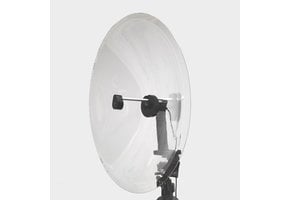
Dodotronic. These models are aimed at users who place higher demands on sound quality and recording performance. Both mono and stereo models are available within this product line.
For professional field recordings and bioacoustic research,
Wildtronics and
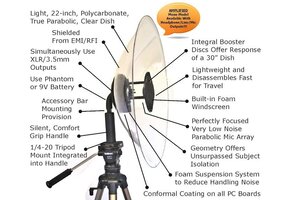
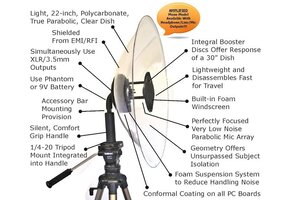
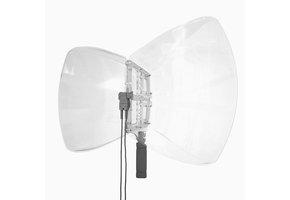
Telinga are also interesting options. Wildtronics focuses, among other things, on low intrinsic noise and a good signal-to-noise ratio. Telinga distinguishes itself through modular systems in which the parabolic microphone can be combined with various microphones and configurations. This makes these systems suitable for intensive fieldwork and advanced recording setups.
Which parabolic microphone is most suitable depends on the intended use, the desired sound quality, the distance to the sound source, portability, and the available budget. For occasional bird observation, a compact model may suffice, while for professional field recordings, a more comprehensive system offers more possibilities.