




Which Bat Detector do I need?
Do you want to hear bats in the garden, or are you conducting professional research requiring long-term and accurate recordings? Which bat detector you need depends entirely on what you plan to do and how intensively you use the device.
At Veldshop, the range of bat detectors is extensive. The devices vary greatly in application, price, specifications, and ease of use. Some models are ideal for an accessible introduction to bats, while others have been specially developed for professional bat research, monitoring, and professional ecological research.
To make choosing the right bat detector as simple as possible, we have divided the range into three clear categories:
- Handheld detectors
- Standalone bat detectors
- Ultrasonic microphones
For each category, we explain when to choose this type, who the devices are suitable for, and what you can do with them. Additionally, we distinguish between detectors for beginners and hobbyists, advanced users, and professional use.
Finally, we list the corresponding products clearly for each subcategory. This way, you can see at a glance which bat detector suits your experience, goal, and working method.
Handheld detectors
You choose a handheld detector if you want to observe bats actively and live in the field. With a handheld detector, ultrasonic bat sounds are immediately converted into audible sound. This allows you to learn to listen, recognize, and compare while you are outdoors.
Handheld detectors are available at various levels: from simple models for beginners to professional hand detectors that also allow recordings to be made for later analysis. Which one suits you best depends on how much control, sound quality, and analysis capabilities you need.
Handheld Detectors for beginners & hobbyists
- Easy to use
- Usually heterodyne listening
- Manual or simple automatic frequency setting
- Immediate results with few settings
Handheld Detectors for advanced users
- Heterodyne combined with time expansion or frequency scanner
- Better sound quality
- More setting options
- Suitable for education and fieldwork
Handheld Detectors for professional use
- Full spectrum and/or extended time expansion
- Save and listen back to recordings
- Suitable for identification and reporting
- Often compatible with external recording equipment
Standalone Detectors
You use a standalone bat detector if you want to monitor bats automatically and unmanned at one or more locations. These detectors are often deployed for several nights or weeks and are suitable for monitoring, research, and ecological studies.
Standalone Detectors for entry-level & simple monitoring
- Full-spectrum recording
- Relatively simple settings
- Suitable for post-analysis
- Runtime of up to approximately 70 hours
Standalone Detectors for Advanced & Professional Use
- Full spectrum (sometimes expandable with zero crossing)
- Long runtime (100-140 hours, possibility to extend)
- Reliable for field research
- Suitable for professional analysis tools
Standalone Detectors for Specialist Use
- Full spectrum and/or zero crossing
- Very long operational lifespan
- Suitable for permanent installations
- Remote data transfer (e.g. GSM)
Ultrasonic Microphones
Ultrasonic microphones are used in combination with a smartphone, tablet, or computer. They convert bat sounds into recordings and sonograms and are suitable for mobile observations, fieldwork, and education.
Ultrasonic microphones for beginners & hobbyists
- Plug-and-play via smartphone or tablet
- Full spectrum recordings
- View sonograms immediately
- Dependent on mobile device
Ultrasonic microphones for advanced use
- Higher sample rates
- More detail in sonograms
- Suitable for analysis on the computer
Ultrasonic microphones for professional use
- Very high resolution (384 kHz)
- Professional analysis capabilities
- Suitable for long-term sessions
- Combinable with Raspberry Pi / Linux solutions
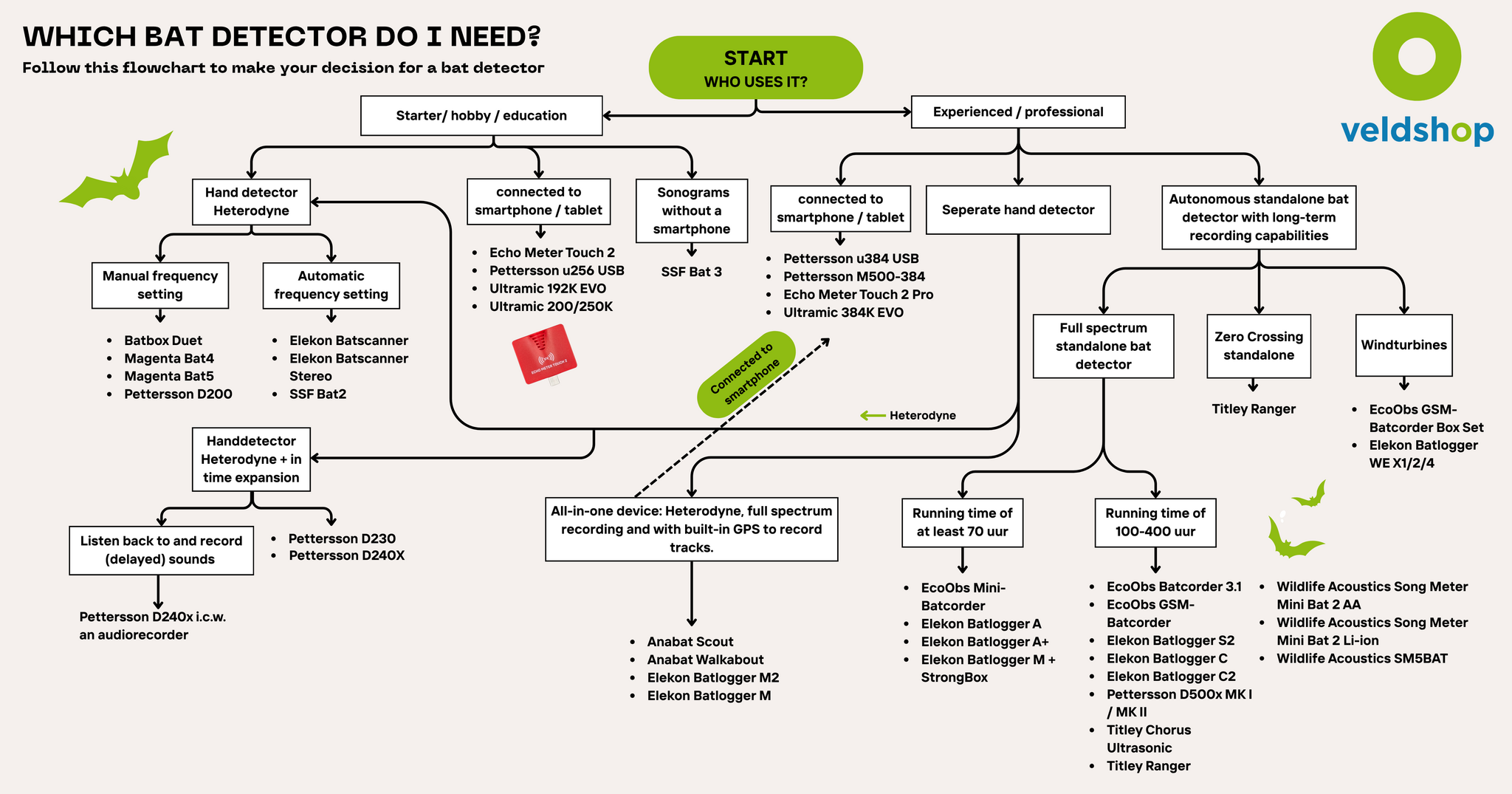
Still unsure which type of bat detector best suits your situation? The flowchart below helps you make the right choice step by step. By answering a few simple questions, such as your experience and your desired device (handheld detector, standalone detector, or ultrasonic microphone), you will arrive at the type of detector that best suits your purpose.
Use the flowchart in combination with the explanation per category above for complete and reliable selection advice.
Common terms for bat detectors explained
When choosing and comparing a bat detector, you will encounter various technical terms. Below, we briefly and clearly explain the most commonly used concepts.
Heterodyne: a listening method in which ultrasonic bat sounds are directly converted into audible sound at a single set frequency. You hear bats live, but see no visual information. Especially suitable for learning to listen and for recognizing species globally.
Sonogram: a visual representation of sound, depicting time, frequency, and intensity. Sonograms are used to analyze bat sounds and accurately identify species, both in the field and afterwards on the computer.
Frequency: the pitch of a sound, expressed in kilohertz (kHz). Different bat species use different frequencies. By knowing the frequency (and seeing it in a sonogram), you can better distinguish species..
Full spectrum: a recording of the complete ultrasonic sound signal of a bat. This provides the most complete information and is suitable for detailed analysis, identification, and reporting. Full spectrum is the standard for professional research.
Time expansion: a technique in which a short fragment of ultrasonic sound is recorded and played back at a slower speed. This allows you to hear more detail than with heterodyne listening. Time expansion is often used in handheld detectors for more accurate listening and comparison.
Zero crossing: a simplified recording method where only the moment the sound signal crosses the zero line is captured. This results in smaller files but contains less detail than full spectrum. It is primarily used for long-term monitoring and automated analyses.
Hopefully, this explanation has helped you choose the right bat detector. Whether you are just starting out observing bats or work on ecological research daily: the right device makes a world of difference in ease of use and results.
Are you still unsure between several models or do you need personal advice? Feel free to contact us via chat, email, or phone. The Veldshop team is happy to help you choose a bat detector that perfectly suits your experience, goals, and work situation.