
Customer Support
0
Close

Categories

Filters

    Microscopes

    Explore our range of microscopes for nature observation, education and professional use. Discover different types and magnifications. Show more

    Brands

    Price

    -
    30 Products
    Carson Hand Microscope 20-60 with LED

    Carson Hand Microscope 20-60 with LED

    This 20-60x hand microscope with LED is compact ...
    €18,95
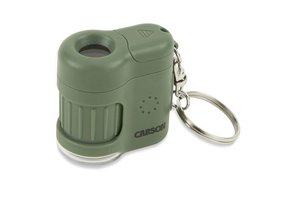
    Carson Pocket Microscope MicroMini 20x

    Carson Pocket Microscope MicroMini 20x

    Perfect for extremely magnifying fabrics, flower...
    €12,95
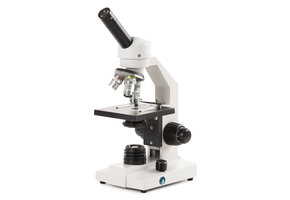
    Euromex LED microscope 40x/100x/400x
    €266,-
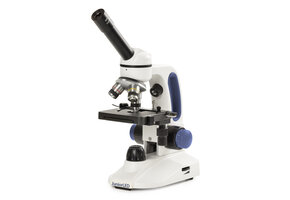
    Euromex JuniorLED microscope 40x/100x/600x
    €141,-
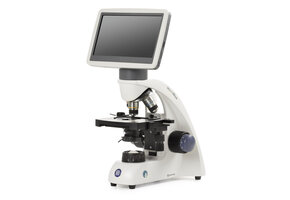
    AmScope Full HD 7" Digital Compound Microscope
    €317,99
    What is a microscope and how does it work?

    A microscope is an optical instrument that allows you to view very small objects and structures under high magnification. It uses lenses to collect light from the object being examined and produce a magnified image. In a traditional light microscope, the image is magnified through the objective lens and eyepiece.
     
    There are different types of microscopes, each designed for specific applications. A stereomicroscope, for example, is used to examine larger objects such as insects, leaves and minerals in greater detail. A biological microscope is designed for studying smaller structures, such as cells, bacteria and other microorganisms.
     
    Microscopes are used in nature observation, biological research, education, laboratory work, technical inspections and various hobbies.
     
    What is the difference between a stereomicroscope and a standard microscope?

    The main difference between a stereomicroscope and a standard biological microscope lies in how the image is displayed and the types of objects you can examine.
     
    A stereomicroscope provides a three-dimensional (3D) image and is suitable for examining relatively large objects at low to medium magnifications. It offers a greater working distance, allowing you to handle or manipulate the object while observing it. This makes it ideal for examining insects, leaves, minerals and small components, for example.
     
    A standard biological microscope is designed for much higher magnifications and for examining thin specimens. It allows you to study cells, bacteria, fungal spores and other microscopic structures. The image is two-dimensional (2D), and the working distance is considerably shorter.
     
    The best choice therefore depends mainly on what you want to examine: larger objects and surfaces or microscopic structures.
     
    What can you view with a microscope?

    With a microscope, you can examine all kinds of small objects and structures that are difficult or impossible to see with the naked eye. Examples include plant cells, animal cells, bacteria, fungal spores and tissue samples.
     
    What you can examine depends on the type of microscope, the available magnification and how the specimen is prepared. A biological microscope, for example, allows you to examine thin specimens and microscopic structures. A stereomicroscope is more suitable for viewing larger objects, such as insects, leaves, minerals and small components, in greater detail.
     
    Both types of microscopes are useful for nature research. For example, you can examine an insect or mushroom with a stereomicroscope and then use a biological microscope to study smaller features, such as spores.
     
    What is the difference between a monocular, binocular and trinocular microscope?

    The difference between monocular, binocular and trinocular microscopes mainly concerns the number of eyepieces and the options for connecting a camera.
     
    A monocular microscope has one eyepiece and is used with one eye. This type of microscope is often a simple and affordable choice for beginners and educational applications.
     
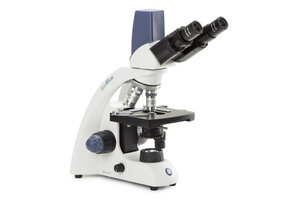
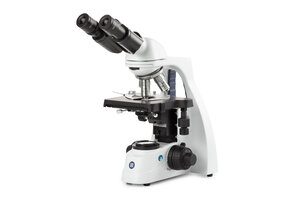
    A binocular microscope has two eyepieces, allowing you to look comfortably through the microscope with both eyes. This is particularly convenient when using the microscope for extended periods.
     
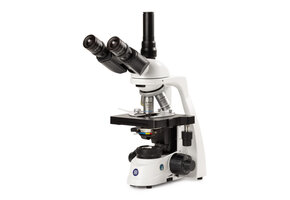
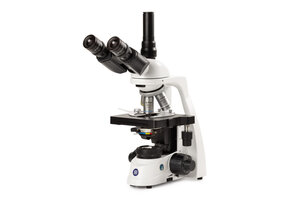
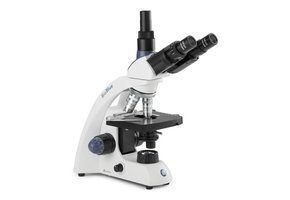
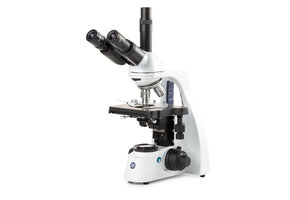
    A trinocular microscope has two eyepieces and an additional connection, also known as a third tube, for a microscope camera. This allows you to look through the microscope while simultaneously capturing images digitally. It is useful for taking photos, recording videos and documenting research results.
     
    The most suitable configuration depends on how you intend to use the microscope, your viewing comfort and whether you want to capture photos and videos.
     
    How do you maintain a microscope?

    Proper maintenance helps preserve the image quality and lifespan of a microscope. Particular attention should be paid to the optical components, such as the objective lenses and eyepieces. Clean these carefully using special lens paper and a suitable lens cleaner. Avoid using ordinary cloths or paper towels, as these can cause scratches.
     
    Avoid touching optical surfaces with your fingers. Skin oils and dirt can reduce image quality. Store the microscope in a dry, dust-free place and use a protective cover whenever possible when the instrument is not in use.
     
    Also check regularly that the mechanical components, such as the focusing mechanism and objective turret, are functioning smoothly. With careful handling and regular maintenance, your microscope will remain in good condition for longer.